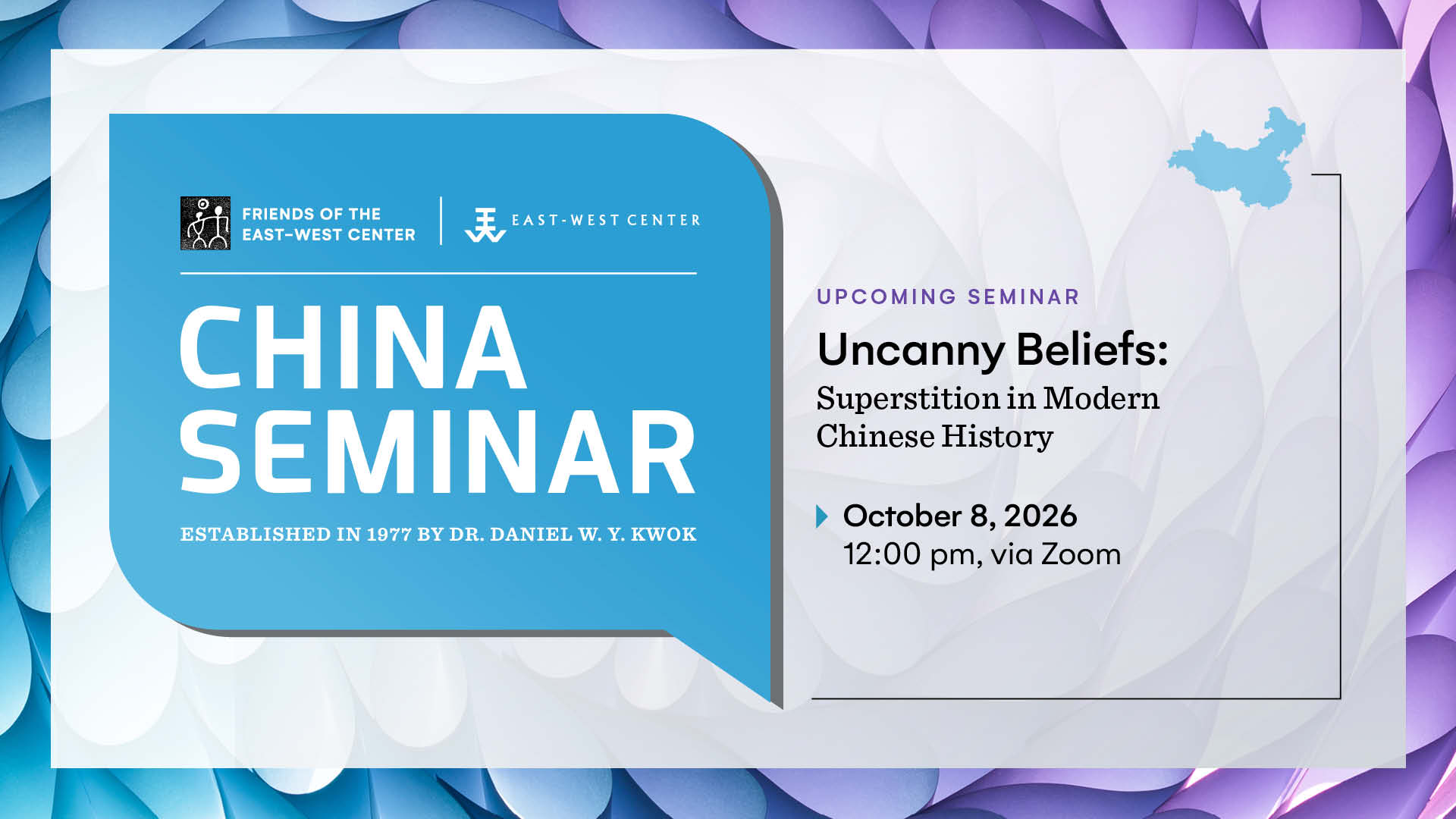
October China Seminar

China Seminar – Thursday, October 8, 2026 | 12pm – 1pm (HST)

Uncanny Beliefs:
Superstition in Modern Chinese History

featuring
Emily Baum
Professor of History, University of California, Irvine
and Director of the Long US-China Institute

Speaker’s summary:
In the early twentieth century, theorists around the world believed that “superstition” belonged to an era destined for irrelevance. Yet despite their confident predictions, so-called superstitions have endured. Perhaps nowhere has the history of superstition been more prolonged and tumultuous than in China. From the late nineteenth century to the present day, intellectuals and governing regimes have denigrated practices like divination, ancestor worship, and geomancy as unscientific, irrational, and unbefitting of a modern nation. Their attempts to root out such practices, however, have regularly encountered resistance from individuals who continue to find meaning in them. This talk, which is based on the speaker’s recent co-edited volume, seeks to understand what “superstition” has meant in modern China – and why acts deemed superstitious have remained so compelling to so many people, even in the face of continuous efforts to eradicate them.

Speaker’s Bio:
Emily Baum is a professor of history at the University of California, Irvine, and the director of the Long US-China Institute. She is the author of The Invention of Madness: State, Society, and the Insane in Modern China (Chicago, 2018) and Needled: How Acupuncture Conquered America (Viking, 2027), and the co-editor (with Albert Wu) of Uncanny Beliefs: Superstition in Modern Chinese History (Harvard Asia Center, 2026). She sits on the board of directors for the Esherick-Ye Foundation and is a faculty advisor for the American Council of Learned Societies – Luce Foundation Program in China Studies.  

The views expressed are those of the speaker and do not necessarily reflect East-West Center policies or positions.

The China Seminar was founded by Dr. Daniel W.Y. Kwok in 1977. Under his guidance, it became a signature program of the Friends of the East-West Center (FEWC) in 2009. The program provides an informal venue for China experts, such as scholars, diplomats, and journalists, to present talks on aspects of China that interest the community and members of the Friends. Topics include politics, economics, social issues, history, culture, food, arts, and many other subjects.
May 2026 China Seminar

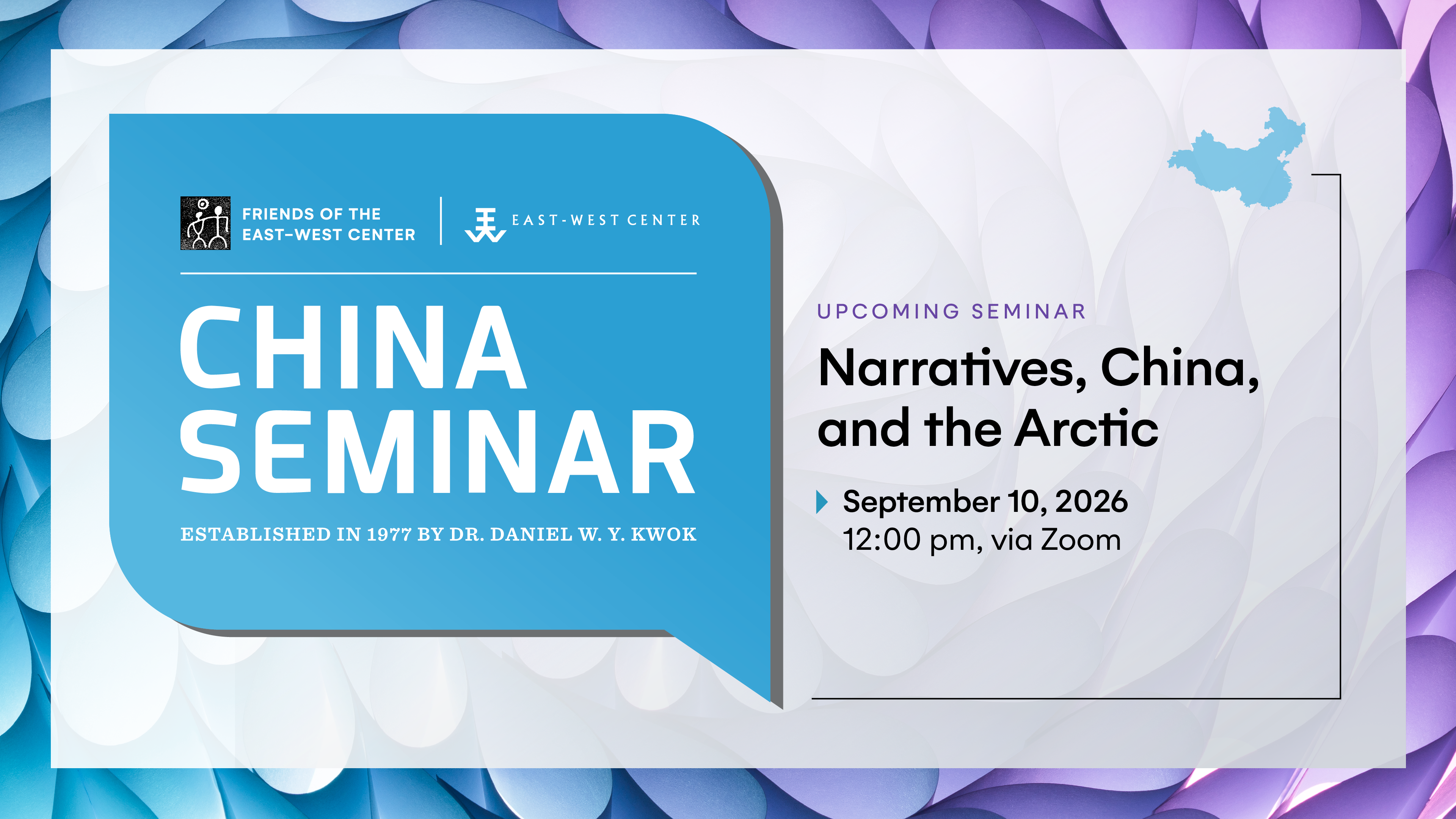
China Seminar – Septmber 10, 2026 | 12pm – 1pm (HST)

Narratives, China, and the Arctic

featuring
Dr. Charles E. Morrison
Senior Fellow and former President of the East-West Center

Speaker’s summary:
Narratives play a powerful role in shaping public and policymaker understanding of issues and intentions. This talk will explore how narratives about China and the Arctic interact to provide a story of China aggressively pursuing resource, transportation, and geopolitical interests in the region.  China’s own rhetoric of a “Polar Silk Road” and China as “a near Arctic state” have buttressed this story. But WHAT do the facts on the ground tell us so far about China’s presence and interest in the region? How does it compare with its interests in other world regions? What assets does it have, and what obstacles does it face? How do its relations with Russia and the United States affect China’s Arctic posture?  

Speaker’s Bio:
Dr. Charles E. Morrison has held several positions at the Center, including president from August 1, 1998 through December 30, 2016.  In these capacities he has had extensive involvement in the conceptualization, organization and funding of multilateral, policy-oriented education, research and dialogue projects. He is a strong advocate of the concept of Asia Pacific community.

He serves on the Standing Committee of the Pacific Economic Cooperation Council and was the organization’s international chair and co-chair from 2005 to 2012. He is a past chair of the US National Consortium of APEC Study Centers and a research adviser to two high-level bi-national Japan-US commissions.  He was associated in the 1980s and 1990s with the Japan Center for International Exchange.  In his early career he served as a legislative assistant to the late Senator William V. Roth, Jr., working primarily on defense, foreign policy, trade, and government ethics issues.

He holds a Ph.D. in international relations from Johns Hopkins School of Advanced International Studies, where he also once taught Southeast Asian international relations.

The views expressed are those of the speaker and do not necessarily reflect East-West Center policies or positions.

The China Seminar was founded by Dr. Daniel W.Y. Kwok in 1977. Under his guidance, it became a signature program of the Friends of the East-West Center (FEWC) in 2009. The program provides an informal venue for China experts, such as scholars, diplomats, and journalists, to present talks on aspects of China that interest the community and members of the Friends. Topics include politics, economics, social issues, history, culture, food, arts, and many other subjects.
April 2026 China Seminar

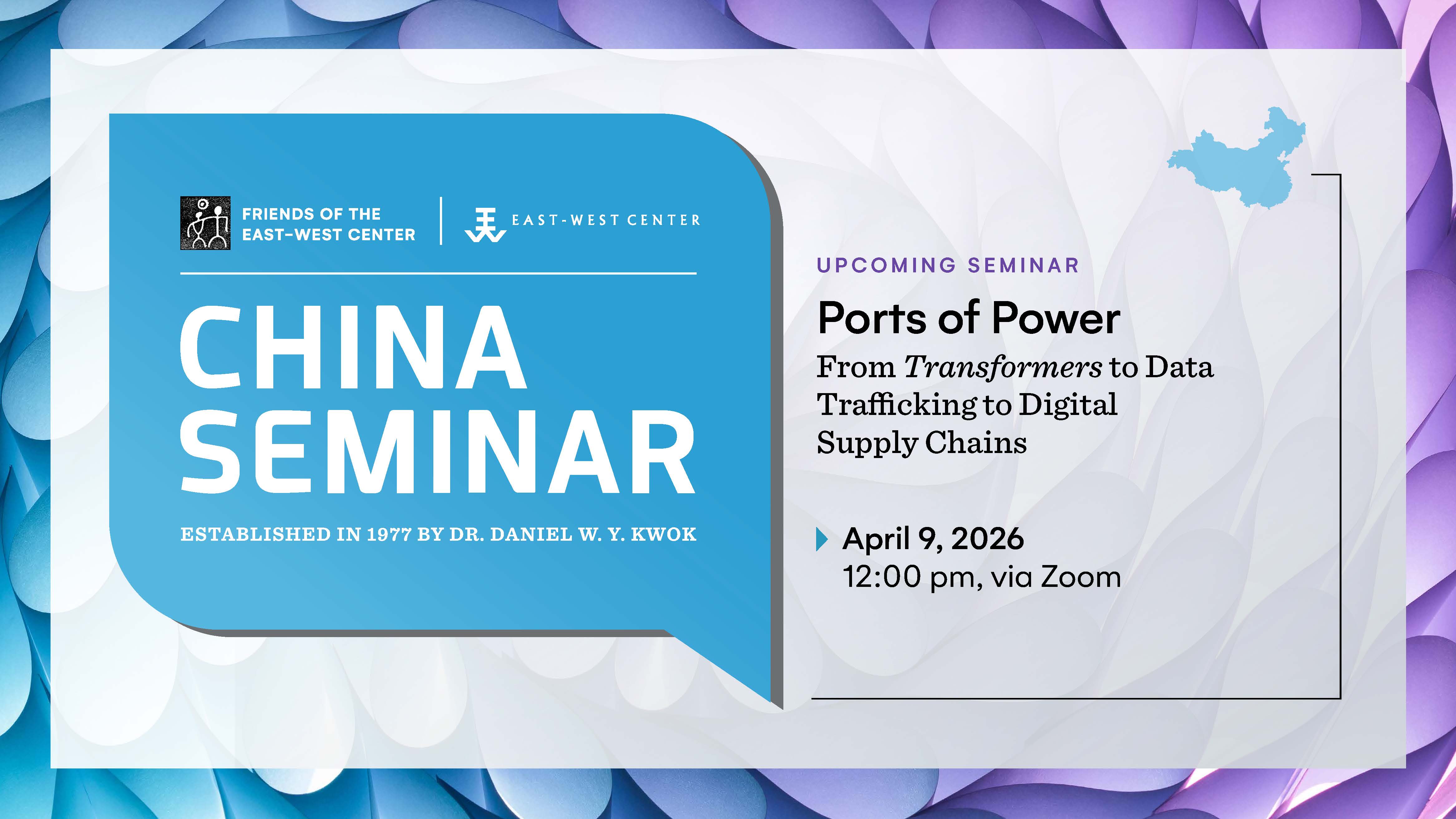
China Seminar – April 9, 2026

Ports of Power
From Transformers to Data Trafficking
to Digital Supply Chains

featuring
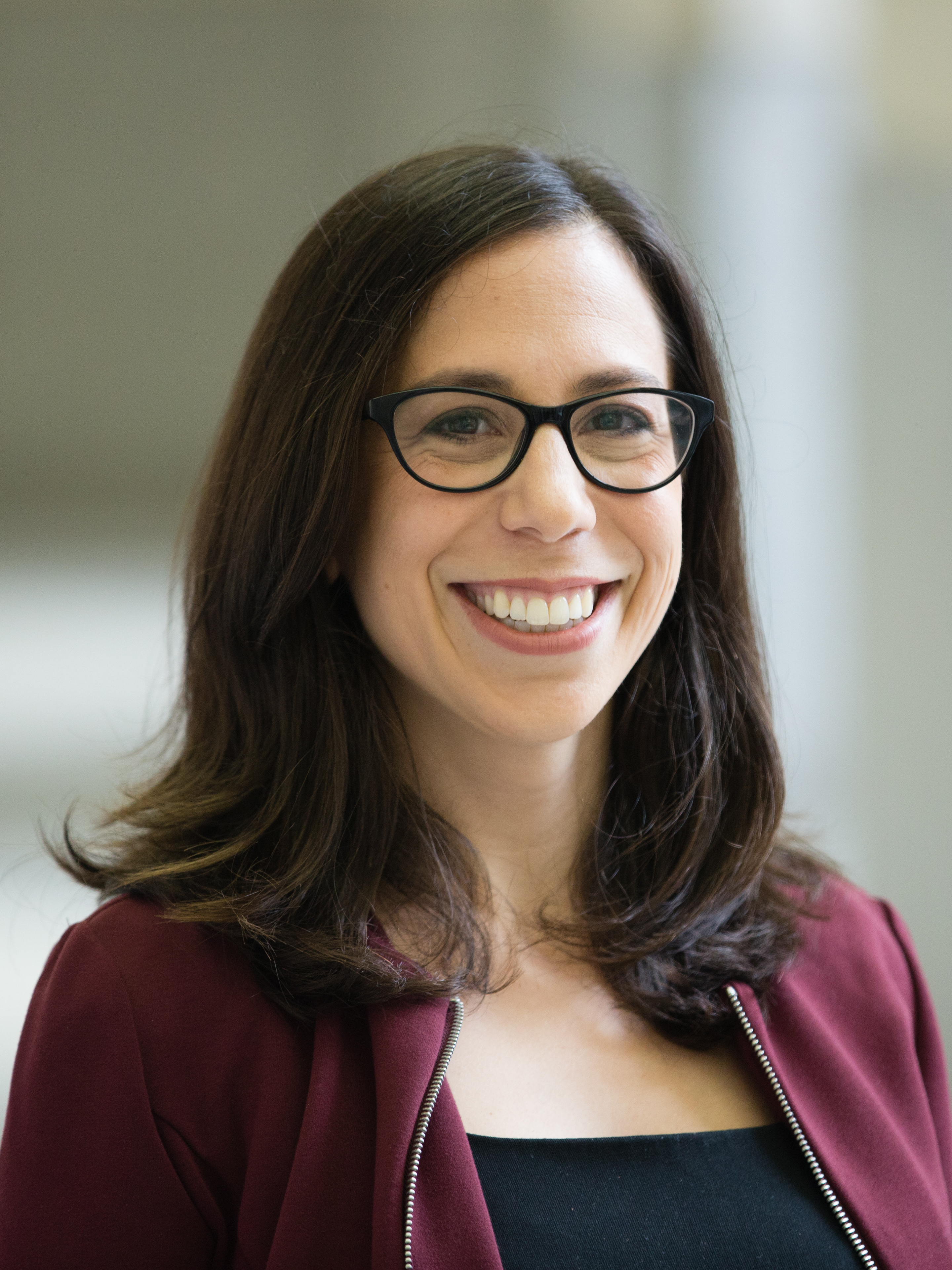
Aynne Kokas
Director, University of Virginia East Asia Center
C.K. Yen Professor, Miller Center for Public Affairs
Professor, Media Studies, University of Virginia

Speaker’s summary:
Globally, China has developed key oversight over ports and supply chains. Logink, the Chinese-owned dominant global supply chain logistics provider, has become the dominant global logistics platform. COSCO, China’s state-owned shipping and port management firm, has become a leader in ownership of key ports globally. The United States Congress has found China’s ZPMC cranes to share undisclosed media and communications. The development of AI systems in port and supply chain management shapes the potential for Chinese government oversight over global shipping, which accounts for over 90% of international trade. For my new project, Ports of Power, I argue that China’s oversight of AI-driven shipping and supply chain infrastructure is crucial to understand in an era of “contested logistics” where dual-use commercial technologies shape global trade and access to key commodities for media, communication, and beyond.

Aynne Kokas is the C.K. Yen Professor at the Miller Center, Director of the East Asia Center and professor of media studies at the University of Virginia. Kokas’ research examines Sino-U.S. media and technology relations. 

Her award-winning second book Trafficking Data: How China is Winning the Battle for Digital Sovereignty (Oxford University Press, October 2022) argues that exploitative Silicon Valley data governance practices help China build infrastructures for global control. Her award-winning first book Hollywood Made in China (University of California Press, 2017) argues that Chinese investment and regulations have transformed the U.S. commercial media industry, most prominently in the case of media conglomerates’ leverage of global commercial brands. 

Kokas is a non-resident scholar at Rice University’s Baker Institute of Public Policy, a life member of the Council on Foreign Relations, and a fellow in the National Committee on United States-China Relations’ Public Intellectuals Program. She has received fellowships from the Library of Congress, National Endowment for the Humanities, Mellon Foundation, Social Science Research Council, Woodrow Wilson Center for International Scholars, Japan’s Abe Fellowship, and other international organizations. Her writing and commentary have appeared globally in more than 50 countries and 15 languages. In the United States, her research and writing appear regularly in media outlets including CNBC, NPR’s Marketplace, The Washington Post, and Wired. She has testified before the Senate Finance Committee, House Foreign Affairs Committee, and the U.S. International Trade Commission.

The views expressed are those of the speaker and do not necessarily reflect East-West Center policies or positions.

The China Seminar was founded by Dr. Daniel W.Y. Kwok in 1977. Under his guidance, it became a signature program of the Friends of the East-West Center (FEWC) in 2009. The program provides an informal venue for China experts, such as scholars, diplomats, and journalists, to present talks on aspects of China that interest the community and members of the Friends. Topics include politics, economics, social issues, history, culture, food, arts, and many other subjects.