
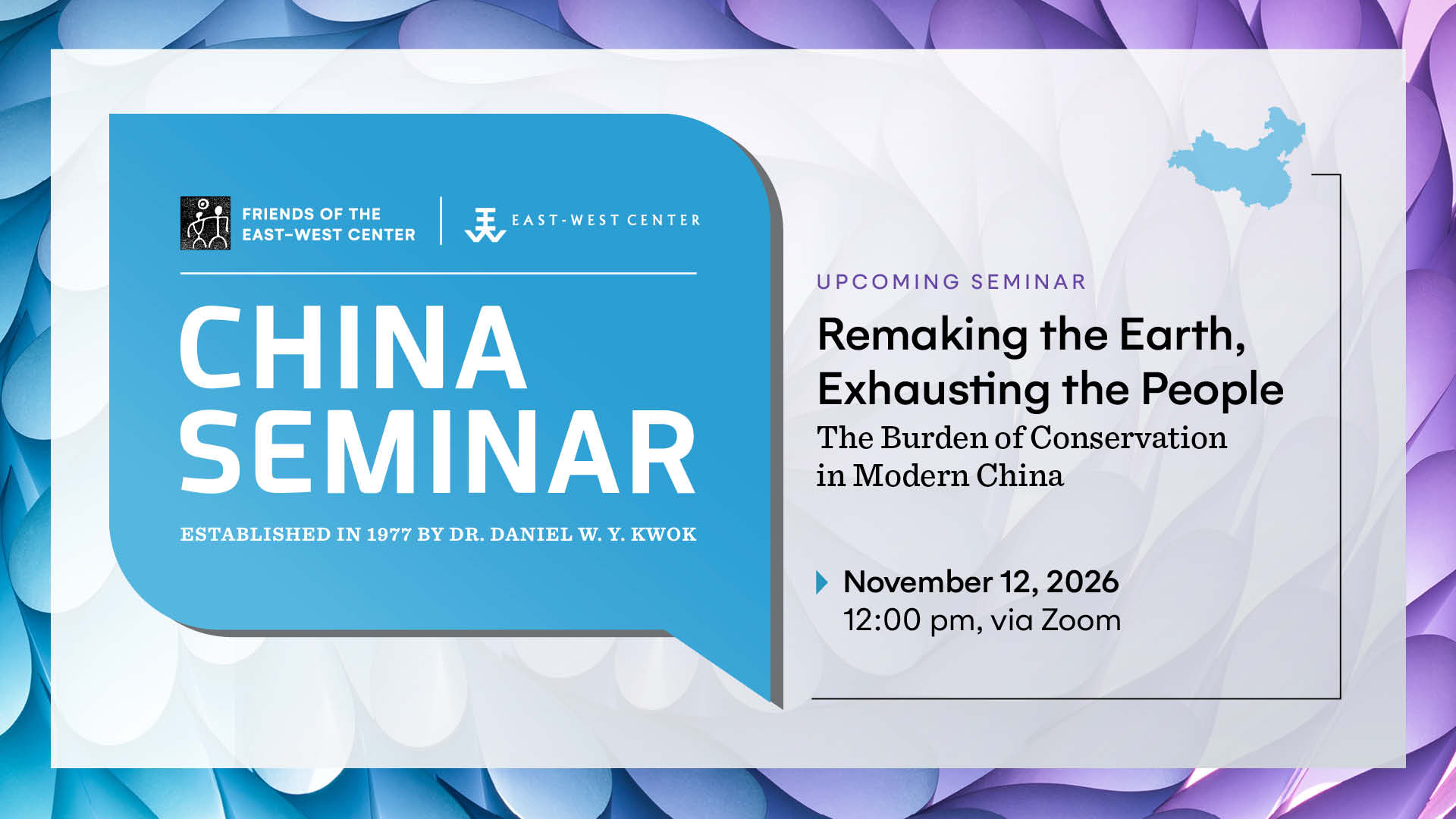
Remaking the Earth, Exhausting the People: The Burden of Conservation in Modern China
featuring
Dr. Micah Muscolino
Professor and Pickowicz Endowed Chair of Modern Chinese History
University of California, San Diego
Speaker’s summary:
From the 1940s to the 1960s, state-led campaigns to conserve soil and water remade both the arid, erosion-prone landscape of Northwest China’s Loess Plateau and the lives of rural people. Drawing from his recent book, Micah Muscolino discusses how the Chinese state imposed the cost of these conservation measures on rural communities and how they navigated those demands. Weaving together archival research and oral history interviews, Muscolino’s multitiered investigation uncovers relationships between the forces of nature, Chinese state policies, and the embodied experiences of rural men and women. Because modern China’s revolutionary transformations fundamentally altered human relationships with the natural world, as his work demonstrates, reconstructing that history from the perspectives of China’s common people requires attentiveness to their everyday interactions with the environment.
Speaker’s Bio:
Dr. Micah Muscolino is Professor and Pickowicz Endowed Chair in modern Chinese history at the University of California, San Diego. He is the author of Fishing Wars and Environmental Change in Late Imperial and Modern China (Harvard Asia Center, 2009) and The Ecology of War in China: Henan Province, the Yellow River, and Beyond, 1938-1950 (Cambridge University Press, 2015). His recent books include Remaking the Earth, Exhausting the People: The Burden of Conservation in Modern China (University of Washington Press, 2025) and the edited volume Revolutionary Natures: Grassroots Environmental Histories of China’s Mao Era (University of Washington Press, 2026).
The views expressed are those of the speaker and do not necessarily reflect East-West Center policies or positions.
The China Seminar was founded by Dr. Daniel W.Y. Kwok in 1977. Under his guidance, it became a signature program of the Friends of the East-West Center (FEWC) in 2009. The program provides an informal venue for China experts, such as scholars, diplomats, and journalists, to present talks on aspects of China that interest the community and members of the Friends. Topics include politics, economics, social issues, history, culture, food, arts, and many other subjects.

